
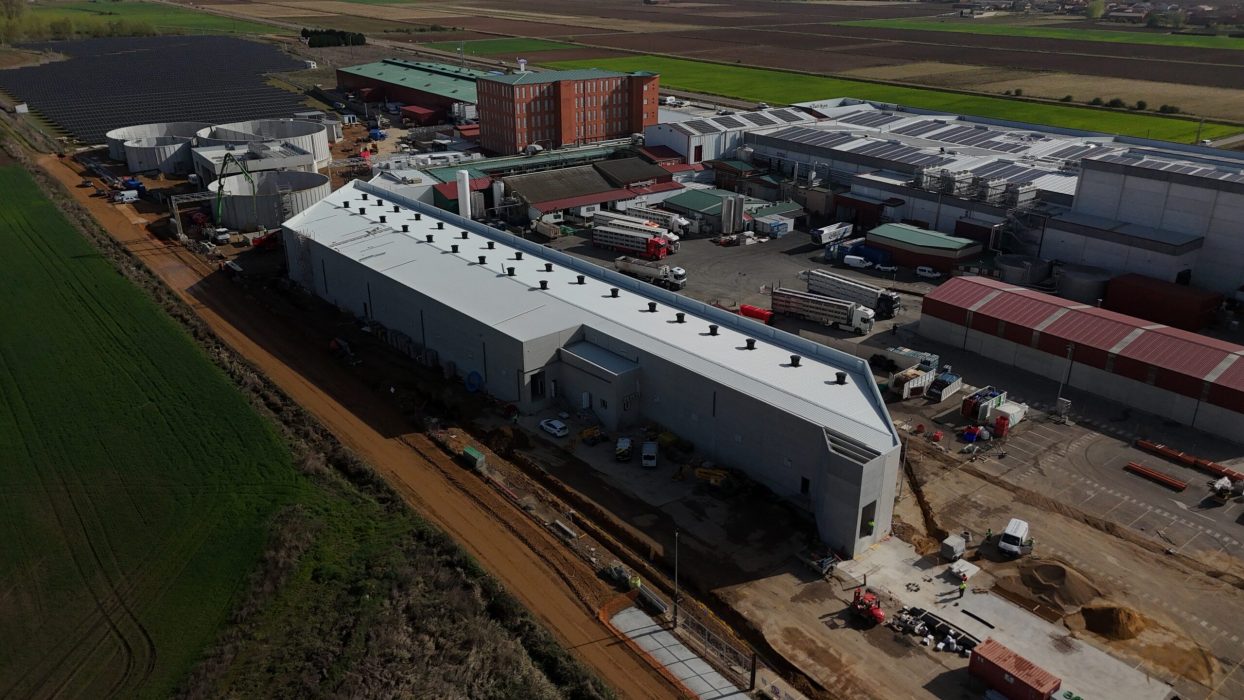
The companies located in Castilla y León account for 20.2% of the Group’s revenue, generate 1,562 industrial jobs and work with 620 integrated farms
Finura represents the company’s commitment to Iberian pork production from farm to table
Vall Companys Group closed the 2025 financial year with revenue of €4.626 billion, according to the annual accounts filed with the Commercial Registry. Originally founded in Lleida, Vall Companys Group has made a strategic commitment to Castilla y León over recent years. Its operations in the region amounted to €934 million during the financial year.
These figures highlight the importance of Castilla y León as a strategic region for the Group’s operations. In 2025, Vall Companys Group’s revenue in Castilla y León accounted for 20.2% of the company’s total turnover and was supported by a regional network of seven workplaces. In total, the Group generates 1,562 jobs across its facilities and works with more than 620 integrated farms.
Specifically, Aldeamayor de San Martín is home to Agrocesa’s feed factory; Tordesillas has an artificial insemination centre; and Soto de la Vega is home to Finura de Ibérico’s pig slaughtering and cutting plant, which also includes a ham-curing facility, in addition to another one located in Cantimpalos. Fuenterroble de Salvatierra is home to Naturíber’s ham and shoulder-curing facility; Villalobón houses La Palentina flour factory; Agroalimentaria Chico is located in Aranda de Duero; and Valladolid has an Avigal multi-meat sales office.
Further investment to maintain its leading position
In a global sector in which Spanish and Castilla y León meat production are international benchmarks, Vall Companys Group invests year after year to maintain its production plants in a leading and competitive position.
The Group’s total investment in the region exceeds €20.8 million. One of its key commitments is the Finura plant in Soto de la Vega, which has become the Group’s main Iberian pig production centre and operates according to high standards of efficiency, sustainability and food safety. Throughout 2025, the company invested €9 million in modernising the facility. Specifically, the investment was allocated to an advanced-technology wastewater treatment plant designed to optimise water treatment and reuse, new unloading pens aimed at improving animal welfare, and the digitalisation of plant processes to optimise operations and eliminate manual tasks.
At a global level, the company, which has made a clear commitment to Castilla y León over recent years, saw its net margin fall to 5.3% of third-party sales. This margin is equivalent to a net profit of €245.4 million. The decline was caused by global instability, as well as by an unexpected end to the year. The declaration of African swine fever (ASF) led to the activation of a contingency plan that affected the company’s 2025 net result.
ASF: market closures, devaluation and contingency plan
African swine fever was declared on 28 November 2025, representing an unprecedented and severe blow to the competitiveness of Spain’s pig sector, both in livestock farming and in the international marketing of meat.
The African swine fever outbreak that began in Bellaterra led to the complete closure of certain export markets, including Japan and Mexico, and the partial closure of others, such as China and the Philippines. The latter were initially completely closed and are now subject to regionalisation measures affecting meat and by-product exports. This situation caused the Mercolleida market price to collapse, leaving white pig farmers facing production costs far above benchmark prices.
In response, the Group’s management activated a financial contingency plan aimed at mitigating the economic and competitiveness crisis caused by the ASF outbreak and the closure of international markets, in anticipation of a highly complex 2026.
In this context, the company has implemented a financial contingency plan to address ASF and its commercial consequences. Initially, a provision of €61 million was made in accordance with the applicable accounting standard resulting from the devaluation of livestock inventories. The planned dividend was also halved, from €72 million to €36 million, while budgeted investment in the Group’s assets for 2026 was reduced from €190 million to €85 million, among other measures.
The emergence of African swine fever represents a serious contingency for the livestock and meat sector, as it devalues pig prices at farm level while fully or partially blocking export markets, some of which are high-value destinations. The situation is further aggravated by the fact that it could continue indefinitely unless wildlife population control measures are introduced to contain the outbreak and eradicate the disease.
International expansion in Latin America
Vall Companys Group has always believed that the best way to protect its business and value chain in Spain is through productive diversification across the Iberian Peninsula —with different business lines and circular economy initiatives— and through an international expansion plan that has been developed since 2016.
To continue diversifying production across different parts of the world, the Group has accelerated its expansion in Latin America by entering two new countries. During 2026, it reached several agreements with Coexca SA in Chile, through its Brazilian subsidiary Master Agroindustrial, and with Grupo Pacuca in Argentina, through a $14 million participating loan.
In addition to these countries, since 2016 Vall Companys Group has gradually acquired minority shareholdings in companies in Peru, Colombia, Uruguay and Brazil. Mexico is the exception, as the Group already holds a 75% stake there. All these transactions have focused on creating synergies, contributing know-how and strengthening the livestock and meat value chain. The investment decisions were based on the fact that these markets had a domestic production deficit, making it necessary to encourage local production.
The Group has strengthened its level of internationalisation. In recent years, exports have enabled many local professionals to develop their careers by specialising in international trade. This international expansion process now represents a growth opportunity for many Vall Companys Group professionals, including veterinarians, agronomists, finance specialists, human resources professionals and engineers, among others.
Commitment to local talent and training
The agri-food Group is committed to an active talent attraction and retention policy. It therefore has more than 200 training agreements with universities and vocational training centres throughout Spain, many of which are located in Castilla y León.
The company has made continuous training a key tool for developing internal talent. Throughout 2025, almost €1.5 million was invested and more than 68,000 hours of training were delivered to the Group’s professionals. As a result, and based on other employability criteria, Vall Companys Group achieved Top Employer certification for the sixth consecutive year. This certification recognises the Group as one of Spain’s leading employers.