Achievable and quantifiable goals
The Penta Programme has set eight basic, measurable objectives for 2030, based on the 130 indicators that will determine the success of all our actions in the coming decade.
| KPIs related tot | Total | % |
|---|---|---|
| Climate and circularity | 47 | 36% |
| Animal welfare | 12 | 9% |
| People | 25 | 19% |
| Quality, safety and innovation | 12 | 9% |
| Ethical and responsible management | 34 | 26% |
| Total | 130 | 100% |
2030 Objectives
The Penta Programme has set eight basic, measurable objectives for 2030.


2030 Objectives
Pillar 1: Climate and circularity
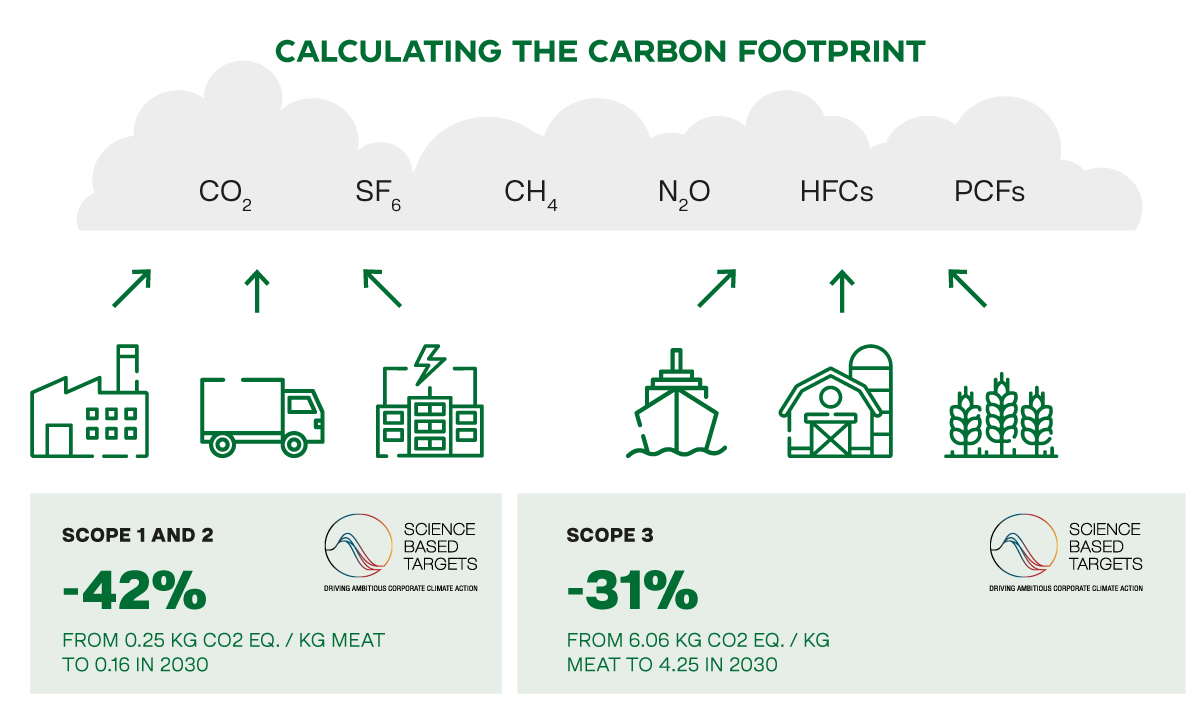
-42% in Scope 1 and 2 emissions
-31% in Scope 3 emissions
Reducing greenhouse gas emissions, one of the main causes of climate change, is a strategic pillar for the development of our activities.
By 2030, we aim to achieve a reduction of 42% in Scope 1 and 2 GHG emissions (expressed as kg CO2 equivalent to one kilo of meat produced). In terms of Scope 1, i.e. those generated directly by our activities, our energy efficiency will be increased through investment in state- of-the-art equipment, the optimisation of our vehicle fleet and the use of digital tools for process control and optimisation.
For Scope 2 emissions, generated by the production of energy consumed, the use of renewable energy sources will be promoted through self-generation with photovoltaic panels and agreements with the main utility suppliers (guarantees of origin).
In addition, we will pursue a 31% reduction in Scope 3 emissions (deriving indirectly from our activities and outside our direct control), through a thorough analysis of our value chain: increasing the supply of sustainable raw materials with a low environmental impact, developing strategies that reduce biogenic emissions on our farms, and promoting the circularity of resources.
-10% in our water consumption
The desertification of ecosystems and droughts mean that fresh water is an increasingly scarce and precious commodity. Given the nature of our activity, this is a particularly sensitive area, and we are therefore committed to improving water quality, the efficient use of water resources, and their comprehensive management.
In the coming years we will reduce the water footprint of our industries, determining the equivalent consumption, and diagnosing our water management. This will help us to identify the stages where it is possible to reuse water or reduce demand, with the aim of achieving a 10% reduction in water consumption by 2030. In addition, we will invest in water treatment measures and technologies to ensure that the water used in our industries is returned in an increasingly better condition.

Pillar 2: Animal welfare
100% on our audited farms
At present all our industries and production systems are certified by recognised animal welfarebodies, such as organic husbandry, Interporc Animal Welfare Spain (IAWS), Welfare Qualityand Global GAP.
In order to ensure the optimum welfare of our animals, the Vall Companys Group includes animal welfare in its research, development and innovation processes, and we have set ourselves the objective for 2030 of auditing 100% of the farms in all our audited divisions, thus reaching the entire livestock production system.
The Vall Companys Group has also developed an organic pork production system in line with the European Green Deal. The Group is committed to promoting this line of business in accordance with consumer demand.


-60% of use
Microbial resistance due to the use of antibiotics is one of the big threats to animal health on a global basis. In view of this challenge, we need to adopt a system of preventive management and biosafety that is capable of reliably protecting our animals from external pathogens while at the same time ensuring a reduction in the use of antibiotic compounds.
The Group’s strategy to reduce the use of antibiotics includes the application of biosafety measures in every phase in which there is interaction with live animals: from genetic cores to birth, weaning, fattening and transport, along with the implementation of preventive programmes: new vaccination programmes, the use of nutraceuticals, and new digital technologies to analyse animal behaviour.
The implementation of this strategy will enable us to reduce the use of antibiotics by 60% by2030 compared to 2015, leaving them to be used exclusively in cases in which, under strictveterinary supervision, they are the last resort to ensure the animal’s health.
Pillar 3: People
To continue being a benchmark employer

The year 2021 started with the Vall Companys Group’s recognition as a Top Employer, recognising the Group’s People Management and Development policies as a benchmark for employment in Spain.
This is a demanding standard that defines our path and obliges us to maintain a strong commitment to the training of our staff, equal opportunities and fairness, promoting safe and healthy habits and an increasingly satisfactory work-life balance.
- Leadership
- Digitisation and flexibility
- Talent attraction
- Development
- Commitment

The Vall Companys Group is a signatory of the Diversity Charter, adhering to current regulations on equal opportunities and non-discrimination and adopting as its own the following basic principles:

1.
Raising awareness of equal opportunities and respect for diversity.
2.
Building a diverse workforce, irrespective of personal or social circumstances.
3.
Promoting inclusion and facilitating effective integration at work.
4.
Managing diversity across the board in human resources policies.
5.
Promoting a work-life balance, harmonising all our staff’s professional and family life.
6.
Recognising the diversity of our clients as a source of innovation and development.
7.
Sharing our commitment to the Diversity Charter with our staff.
8.
Informing our suppliers of our commitment and inviting them to join it.
9.
Informing public administrations and social agents of our commitment.
10.
Reflecting our activities and results in the company’s annual report.
Job stability and the development and training of our employees is a key vector for growth in the Vall Companys Group. The number of employees hired by the Group has grown steadily year on year and we expect this trend to continue in the future. In terms of training, after an atypical 2020 due to the situation caused by the pandemic, the Group plans to continue with a sustained increase in our investments in training and the number of hours dedicated to it.
Pillar 4: Quality, safety and innovation
The European Green Deal and the legislative framework have already defined a clear horizon for packaging, stating that by 2026 there must be a quantitative decline in the use of single- use plastics compared to 2022 (including food-grade plastics), and a progressive increase in the use of recycled materials.
For the coming years, the Vall Companys Group has set itself the task of unifying the criteria for registering and classifying packaging according to the type of material and the proportion of it that is recycled, and to establish a comprehensive packaging strategy which means that 50% of the plastic used will be recyclable by 2025, and 60% by 2030.
Over this period, we intend to promote the use of recycled materials with the aim of ensuring that 100% of the paper and cardboard we use in 2030 will be recycled.

0.6% of our turnover
Innovation is a pillar that supports the whole of our sustainability strategy. As leaders in the agri-food sector in both Spain and Europe, we have the responsibility to move forward in increasingly safe and efficient production techniques, with a lower environmental impact and supported by digital tools that ensure the sustainability of our activities.
Through to 2030, the Group is committed to reinvesting 0.6% of its annual sales in R&D&I projects aligned with its sustainability strategy. In this context, lines of research will be geared towards reducing the carbon footprint of our processes, improving the circularity of resources, increasing the shelf life of our food products, evaluating new eco-sustainable packaging, and developing new food products that meet consumer demands.
Pillar 5: Quality, safety and innovation
The Vall Companys Group has always been characterised by its ethical management, encouraging every member of its team to exercise responsible, sound and transparent leadership. Continuing this working philosophy will be a challenge in the coming decade, given the size and diversity of our employee base.
To this end, all our decisions are based on ethical criteria and strict compliance with the law, enshrined in the Group’s Code of Ethics and Crime Prevention Plan: frameworks that are both mandatory for all companies and professionals working in the Group as well as its clients, suppliers, and other people or entities we liaise with.
In turn, the Vall Companys Group is strongly committed to respect for human rights: all the processes in our productive structure take place in fair working environments, governed by values such as respect for human dignity, individual autonomy, and equality.
The Group is committed to continuing to promote this type of management through the different departments involved.

100% sustainable suppliers
100% responsible soy
Of all the external agents involved in our value chain, the supply of raw materials for manufacturing compound feed is a key factor in ensuring our quantitative contribution to the different sustainability indicators.
In addition to the guaranteed traceability of our supply chain, our goal is to inform and encourage all our suppliers to accredit the fact that their own value chain is responsible and sustainable. Consequently, a process to standardise suppliers has been initiated, in accordance with sustainability criteria, with regard to both Spanish and international raw materials.
The raw material with the greatest impact is soy and its derivatives. We have therefore set the following objectives: reducing dependence on soybeans for animal feed by promoting the viable use of alternatives, and ensuring that by 2030 all soybeans are sustainable and sourced from non-deforested areas.
This will be undertaken through certified guarantees from suppliers and the purchase of RTRS credits. The Vall Companys Group is a member of the Round Table on Responsible Soy Association (RTRS), an organisation that promotes the growth and production of responsible soy from an environmental, economic and social point of view.