


Reducing the environmental impact
Climate change is one of the biggest challenges of our time, and fighting it means defending our development as a species. Water, emissions, energy, circularity… we reduce the environmental impact of our activities and look for new uses in our production processes. We seek the maximum efficiency in everything we do.
Strategic lines of the pillar
- Integrated, cross-cutting environmental management
- Calculation, reduction and offsetting of GHG emissions.
- Safe, sustainable and efficient mobility.
- Energy efficiency: lower consumption and greener energy.
- Circularity: making better use of resources and minimising waste.


2030 Objectives
Pillar 1: Climate and circularity
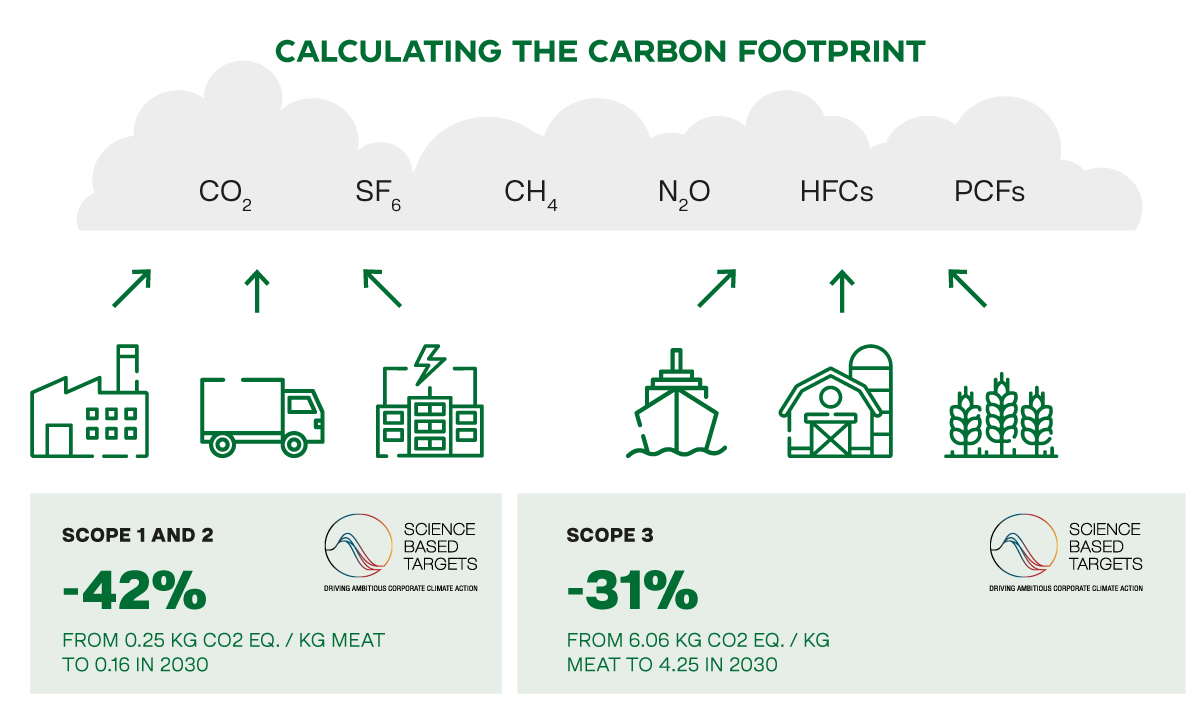
-42% in Scope 1 and 2 emissions
-31% in Scope 3 emissions
Reducing greenhouse gas emissions, one of the main causes of climate change, is a strategic pillar for the development of our activities.
By 2030, we aim to achieve a reduction of 42% in Scope 1 and 2 GHG emissions (expressed as kg CO2 equivalent to one kilo of meat produced). In terms of Scope 1, i.e. those generated directly by our activities, our energy efficiency will be increased through investment in state- of-the-art equipment, the optimisation of our vehicle fleet and the use of digital tools for process control and optimisation.
For Scope 2 emissions, generated by the production of energy consumed, the use of renewable energy sources will be promoted through self-generation with photovoltaic panels and agreements with the main utility suppliers (guarantees of origin).
In addition, we will pursue a 31% reduction in Scope 3 emissions (deriving indirectly from our activities and outside our direct control), through a thorough analysis of our value chain: increasing the supply of sustainable raw materials with a low environmental impact, developing strategies that reduce biogenic emissions on our farms, and promoting the circularity of resources.
-10% in our water consumption
The desertification of ecosystems and droughts mean that fresh water is an increasingly scarce and precious commodity. Given the nature of our activity, this is a particularly sensitive area, and we are therefore committed to improving water quality, the efficient use of water resources, and their comprehensive management.
In the coming years we will reduce the water footprint of our industries, determining the equivalent consumption, and diagnosing our water management. This will help us to identify the stages where it is possible to reuse water or reduce demand, with the aim of achieving a 10% reduction in water consumption by 2030. In addition, we will invest in water treatment measures and technologies to ensure that the water used in our industries is returned in an increasingly better condition.
